Your Business Has an Operating Logic. Your ERP Should Reflect It.
A configured ERP you own — built around your actual workflows, not the other way around.
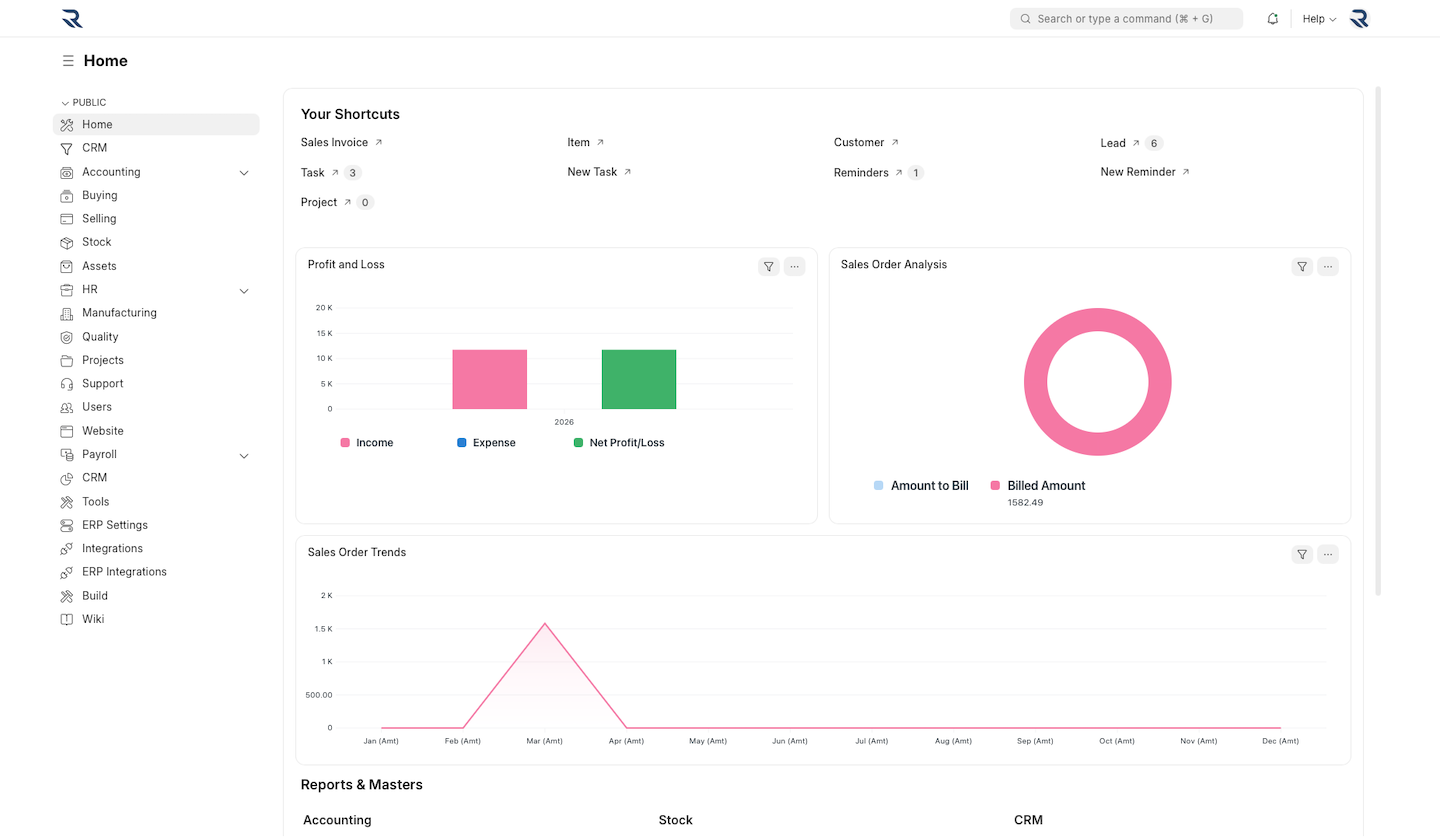
https://erp.yourcompany.com
When your business runs on one clear operating picture
No one waiting on approvals
Every team knows what's next
Month-end without the scramble
Cost picture holds mid-quarter
Processes outlast the people who built them
New hires follow the system, not a person
Software cost fixed, not compounding
Audit-ready without a fire drill
A few questions worth sitting with:
Do you own your operations data — or do you just have access to it?
or
If your ERP provider raised prices by 40% next year, what would your options actually be?
- If either answer gave you pause, you're in the right place.
Ownership was always the serious choice
At > ~10 people, your systems should be assets on your books — not recurring obligations on your vendor's revenue forecast.
Fixed Cost Floor
One configuration cost. No per-seat fees compounding as your team grows.
Predictable Budget
Your ERP cost next year is the same as this year — you set it.
Your Infrastructure
Data lives on your private cloud — not a shared environment you don't control.
Full Portability
Your data exports completely — no proprietary format holding it in place.
Vendor Independence
Any qualified developer can work on your system — you choose who, always.
Configuration Rights
Workflows change when your business changes — not when a pricing tier allows it.
Owning your software isn't a radical idea!
It's the same instinct that led you to every other decision, that gave your business stability.
What you already own
Your business equipment
You bought the tools your team needs. You didn't lease a laptop per employee per month with a clause that doubles when you hire.
The same logic applies to
Your software infrastructure
A one-time investment that doesn't compound against you as you grow. No per-seat penalty for building a bigger team.
Every new hire shouldn't automatically increase your software overhead. Ownership means your costs don't scale with your headcount.
The businesses that make this shift don't do it because it's new. They do it because once they see the numbers, the subscription model stops making sense.
A working day where the system already knows
How daily users, team leads, and owners each experience a business running on one configured system.
Every purchase request follows the same path
Material requests move through your configured approval chain automatically. No one chases a signature or wonders where it went.
Invoices go out without a reminder
Sales orders convert to invoices based on your defined workflow. The billing cycle runs without a manager prompting it.
Stock levels flag themselves before a problem forms
Reorder thresholds are set per item and warehouse. The system raises a material request — the manager sees it, not a stockout.
Month-end closes without a fire drill
General ledger, payables, and receivables reconcile from the same transaction records. No spreadsheet consolidation at the end of the month.
New staff follow the process, not a person
Workflows, approval rules, and document sequences are built into the system. Operational knowledge doesn't leave when someone does.
Compliance posture holds without a dedicated effort
Tax rules, financial statements, and audit trails are maintained by the system as transactions happen — not assembled before a review.
Every function your business runs, mapped clearly
Grouped by what your team does — not how the software is built.
Finance & Accounting
Every number your business produces, traceable to its source.
- General ledger tracks every transaction across your defined accounts
- Accounts payable and receivable managed from the same system as your orders
- Financial statements generated from live data — no manual assembly
- Multi-currency transactions recorded and reported in your base currency
- Tax rules configured to your country and entity structure
Procurement & Suppliers
Every purchase follows a path your business defined.
- Material requests trigger purchase orders through your approval chain
- Multi-level approvals configured to your authorisation thresholds
- Supplier scorecards track delivery and quality over time
- Procure-to-pay cycle closes in the same system that raised the request
- Purchase history visible per supplier — no spreadsheet cross-referencing
Sales & Order Management
Quotes become orders become invoices — without manual handoffs.
- Sales orders convert to invoices based on your defined billing rules
- Pricing rules configured per customer, territory, or volume tier
- Print formats for quotes and invoices match your business documents
- Order-to-cash cycle tracked in one record from first quote to payment
Stock & Inventory
Every item, every movement — known before it becomes a problem.
- Reorder thresholds set per item and warehouse trigger material requests
- Serial and batch tracking follows items from receipt to dispatch
- Stock ledger records every movement with the transaction that caused it
- Multiple warehouses managed with item defaults configured per location
- Inventory reports reflect current position — not last night's export
Workflow & Approvals
Your process runs consistently — regardless of who is in the office.
- Approval workflows built to match your authorisation structure
- Document stages defined by your process — not the software's defaults
- Role-based permissions control what each person can see, edit, or submit
- Automated assignments route documents based on rules you configure
Reporting & Visibility
The information leadership needs — current, structured, and traceable.
- Standard financial and operational reports available without IT involvement
- Custom reports built on your fields and your document relationships
- Dashboards configured to surface the numbers each role needs daily
- Audit trail on every document shows who changed what and when
Built around how your industry actually operates.

Production, inventory, and procurement stay aligned across every stage.
ERP connects planning, materials, and financials, making production schedules clearer, inventory levels more accurate, and decisions faster with real-time visibility across operations.

Inventory, orders, and deliveries move in a coordinated flow.
ERP centralizes stock, order processing, and supplier coordination, improving fulfillment speed, reducing manual tracking, and giving clear visibility into inventory and cash flow at any time.

(Construction, Engineering, Architecture, Contracting)
Projects move forward with clear timelines, resources, and budgets.
ERP brings together project tracking, resource planning, and financials, making job costing clearer, timelines easier to manage, and coordination across teams and sites more consistent.

(HVAC, Elevators, Plumbing, Electrical etc)
Service schedules, teams, and resources stay coordinated daily.
ERP links scheduling, work orders, inventory, and billing, helping teams respond faster, manage field operations efficiently, and maintain clear visibility into service performance and revenue.
Production, inventory, and procurement stay aligned across every stage.
ERP connects planning, materials, and financials, making production schedules clearer, inventory levels more accurate, and decisions faster with real-time visibility across operations.
Healthcare
Real Estate
Entertainment and Media
Finance and Banking
Education
Construction
Hospitality and Tourism
Manufacturing and Industrial
Retail and E-commerce
Non-profit and Social Services
Foodservice
Transportation and Logistics
Healthcare
Real Estate
Entertainment and Media
Finance and Banking
Education
Construction
Hospitality and Tourism
Manufacturing and Industrial
Retail and E-commerce
Non-profit and Social Services
Foodservice
Transportation and Logistics
Healthcare
Real Estate
Entertainment and Media
Finance and Banking
Education
Construction
Hospitality and Tourism
Manufacturing and Industrial
Retail and E-commerce
Non-profit and Social Services
Foodservice
Transportation and Logistics
Healthcare
Real Estate
Entertainment and Media
Finance and Banking
Education
Construction
Hospitality and Tourism
Manufacturing and Industrial
Retail and E-commerce
Non-profit and Social Services
Foodservice
Transportation and Logistics
Healthcare
Real Estate
Entertainment and Media
Finance and Banking
Education
Construction
Hospitality and Tourism
Manufacturing and Industrial
Retail and E-commerce
Non-profit and Social Services
Foodservice
Transportation and Logistics
Healthcare
Real Estate
Entertainment and Media
Finance and Banking
Education
Construction
Hospitality and Tourism
Manufacturing and Industrial
Retail and E-commerce
Non-profit and Social Services
Foodservice
Transportation and Logistics
Healthcare
Real Estate
Entertainment and Media
Finance and Banking
Education
Construction
Hospitality and Tourism
Manufacturing and Industrial
Retail and E-commerce
Non-profit and Social Services
Foodservice
Transportation and Logistics
Healthcare
Real Estate
Entertainment and Media
Finance and Banking
Education
Construction
Hospitality and Tourism
Manufacturing and Industrial
Retail and E-commerce
Non-profit and Social Services
Foodservice
Transportation and Logistics
Transportation and Logistics
Foodservice
Non-profit and Social Services
Retail and E-commerce
Manufacturing and Industrial
Hospitality and Tourism
Construction
Education
Finance and Banking
Entertainment and Media
Real Estate
Healthcare
Transportation and Logistics
Foodservice
Non-profit and Social Services
Retail and E-commerce
Manufacturing and Industrial
Hospitality and Tourism
Construction
Education
Finance and Banking
Entertainment and Media
Real Estate
Healthcare
Transportation and Logistics
Foodservice
Non-profit and Social Services
Retail and E-commerce
Manufacturing and Industrial
Hospitality and Tourism
Construction
Education
Finance and Banking
Entertainment and Media
Real Estate
Healthcare
Transportation and Logistics
Foodservice
Non-profit and Social Services
Retail and E-commerce
Manufacturing and Industrial
Hospitality and Tourism
Construction
Education
Finance and Banking
Entertainment and Media
Real Estate
Healthcare
For the people who know exactly where the gaps are
From the owner watching margin disappear into spreadsheets, to the team lead chasing approvals — each role has a stake in how this system runs.
Business Owner
Finance Manager
Operations Manager
Sales Coordinator
Department Head
Business Owner
Accountable for the numbers but dependent on others to assemble them.
Our Process
- 01
Fit conversation
This is not a demo. It's not a sales call with a deck and a closing question at the end. It's a direct conversation about your business — how it operates, what's working, what's creating friction, and what a better system would make possible. We're assessing fit as honestly as you are.
- 02
Discovery & Research
If the fit conversation goes well and both sides want to proceed, we spend time getting the full picture. Not the surface level — the actual workflows, the edge cases, the way your team really operates. This phase is where most of the value gets created, and most implementors skip it.
- 03
Proposal and approval
Based on discovery, we assess what already exists in the open-source ecosystem we leverage, what needs configuration, and what needs integration. We don't build what doesn't need building — that cost lands on you. What comes back is a specific proposal: what gets built, what it costs, no ambiguity.
- 04
Configure and Build
The system is configured and built on your private cloud instance according to the approved specification. You don't need to be involved daily — but you're involved at every meaningful milestone. Review sessions are structured so you're evaluating what matters: does this reflect how your business works? Is this what we agreed on?
- 05
Training and handover
Training is conducted on your system, using your data, reflecting your actual workflows. We train the people who will use it — not just the administrator. By the end of the handover week, your team is operating independently. We don't build dependency into the relationship.
- 06
Support & documentation
Once you're operational, you receive full documentation of everything built — written for your configuration, not a generic manual. From there, an optional yearly support contract covers updates, backups, and system monitoring. You choose whether to take it.
What comes with every deployment
Every deployment includes consultation, integration, and an optional support structure — not because they're upsells, but because a configured system without them isn't actually complete.
Consultation and configuration
Not software handed over with a manual. Every deployment starts with understanding how your business actually operates — and ends with a system built around that understanding.
Discovery sessions with the people who will use the system daily
A written configuration specification you approve before build begins
Training conducted on your system, using your data and your workflows
Handover only when your team is running independently — not when a date arrives
This phase takes more of your time than most clients expect. The quality of what gets built is directly proportional to the quality of what we learn here.
Integrations scoped and built
The application doesn't operate in isolation. Connections to your existing tools and to the other apps in the suite are assessed during discovery and built into the implementation.
Every integration identified and scoped before a price is agreed
Connections to your accounting, email, and existing business tools
Apps within the suite share the same data — no duplicate entry, no sync failures
API and webhook integrations for tools outside the standard ecosystem
You don't pay separately to make things talk to each other. Integration is not a bolt-on — it's part of how a configured system gets built.
Optional yearly support contract
Once you're operational, an optional yearly contract covers the ongoing maintenance of your system. You choose whether to take it. Nothing stops working if you don't.
Platform updates and security patches applied on a regular schedule
Automated backups with defined retention and recovery procedures
System monitoring with a defined response SLA for operational issues
A fixed annual cost that doesn't change based on usage or team size
Most clients renew because operational peace of mind has real value. We don't structure this contract to create renewal anxiety — you're in it because it's worth it, not because leaving would break something.
... and ERP is just the beginning
Your ERP can be part of a connected system - Smart Business System (SBS). Every app shares the same data, the same platform, the same source of truth.
- Learn More
CRM
Customer relationships, fully owned
- Learn More
ERP
Operations and finance, connected
- Learn More
Knowledge Base
Company knowledge, always accessible securely
- Learn More
HR & Payroll
Your people, properly managed
- Learn More
Marketing Automation Tools
Campaigns that run on real data
- Learn More
Learning Management System (LMS)
Train your team, track progress
- Learn More
Business Insights
Decisions backed by your numbers
- Learn More
Helpdesk
Support requests, resolved and recorded
Why businesses run on systems we've delivered.
At Rollout Technologies, we configure and deliver business software for growing Small and Medium-sized companies — systems your team owns, controls, and builds on long-term.
From professional services and wholesale distribution to manufacturing and healthcare — we've helped businesses who outgrew generic tools.
Common Questions & Answers
Still have questions?
Explore more answers to help you evaluate what fits your business.
Lloyd Oslar
CEO
Cale Parkyn
Owner

Dr. Jagdeep Singh Brar
Owner

Tanner Rose
Ex General Manager
Joshua Kuriakose
Founder
Montrose Pet Clinic
Owner
Tejas Surve
Director
James
Owner



Most good decisions start with one honest conversation.
Resources
Blog
Coming Soon!
Case Studies
Coming Soon!