Your sales process shouldn't live in someone else's system.
A fully configured CRM, built around how your team actually sells — hosted on your own private cloud, with no per-seat fees and no data leaving your hands.
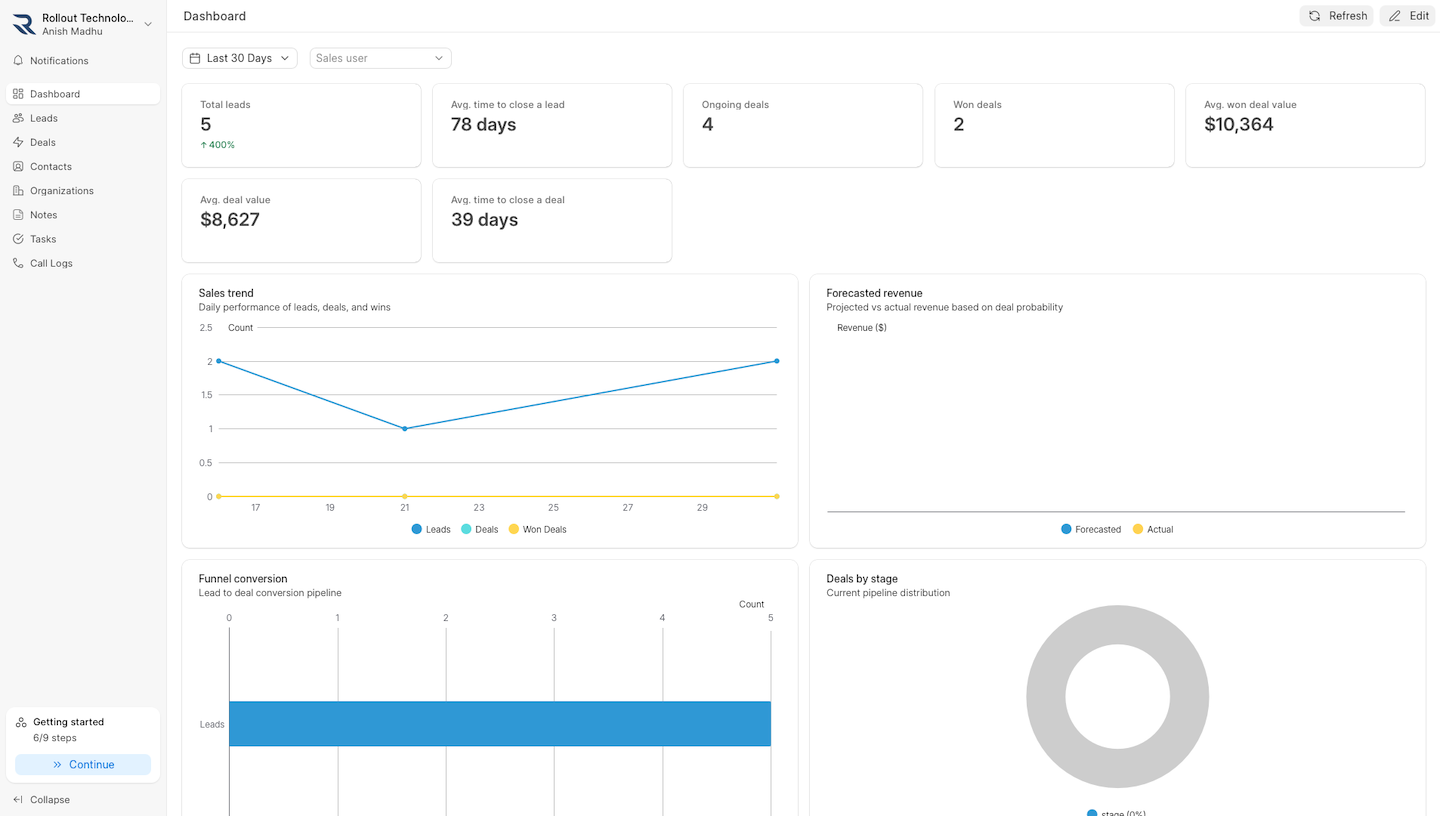
https://crm.yourcompany.com
When your sales pipeline becomes a business asset
No lead falls through silence
Reps work from facts, not memory
Pipeline clear before every meeting
Forecast gaps visible before they hurt
Client history survives staff changes
Nothing walks out with a resignation
Headcount grows, software bill doesn't
Your data stays where you put it
A few questions worth sitting with:
Do you own your customer data — or do you just have access to it?
or
If your CRM provider raised prices by 40% next year, what would your options actually be?
- If either answer gave you pause, you're in the right place.
Your CRM should be an asset, not a recurring expense
At more than 10 employees, renting your sales infrastructure means your costs grow every time your team does — ownership ends that equation for good.
Predictable Cost Floor
One configuration cost. Your bill doesn't rise when you hire.
No Seat Tax
You decide who accesses the system — not a vendor's pricing tier.
Your Data, Your Server
Customer records live on your private cloud — not a shared platform.
Full Portability
Your data exports cleanly — no hostage situations at contract end.
Vendor Independence
Any qualified developer can work on your system — not just us.
Configuration Rights
You own the system, so you decide when and how it changes.
Owning your software isn't a radical idea!
It's the same instinct that led you to every other decision, that gave your business stability.
What you already own
Your business equipment
You bought the tools your team needs. You didn't lease a laptop per employee per month with a clause that doubles when you hire.
The same logic applies to
Your software infrastructure
A one-time investment that doesn't compound against you as you grow. No per-seat penalty for building a bigger team.
Every new hire shouldn't automatically increase your software overhead. Ownership means your costs don't scale with your headcount.
The businesses that make this shift don't do it because it's new. They do it because once they see the numbers, the subscription model stops making sense.
What your sales operation looks like when it actually works
Leads, conversations, follow-ups, and pipeline visibility — all in one system that works the way you do.
Every conversation lives on the deal record
Emails, calls, and WhatsApp messages are all logged against the lead. No rep reconstructs context from memory or a scattered inbox.
Manager sees every rep's pipeline without asking
Board and list views show deal stage, assigned rep, and last activity in plain view. No status meeting required to know where things stand.
Cold deals surface before they become lost deals
Activity thresholds flag deals with no movement inside your defined window. A manager sees stalled pipeline before the quarter closes around it.
Customer history stays when a salesperson leaves
Every call, note, and deal stage is stored against the contact record — not in someone's inbox. A new rep picks up exactly where the last one stopped.
The system grows with headcount — the bill does not
CRM is not priced per seat. Adding three reps next quarter adds no new line item to your software cost.
Leads from Meta arrive without anyone touching them
Facebook and Instagram leads pull directly into the pipeline with all fields filled. No CSV downloads, no copy-pasting, no leads missed between platforms.
Every capability your sales operation needs, where you expect it
Not a list of features. A set of capabilities that work together from day one.
Lead & Deal Management
Every lead and deal tracked — nothing lost, nothing assumed.
- Leads, contacts, deals, and organisations on one unified record.
- Deal stages defined by your process, not a generic default.
- Board and list views for different rep working styles.
- Full deal history stays on the record — not with the rep.
Communications & Follow-Up
Every channel logged — no lead goes cold by accident.
- Emails, calls, WhatsApp, and notes tracked on one deal record.
- Reps message leads via WhatsApp directly inside the CRM.
- Internal team discussions attached to deals, not side channels.
- Follow-up tasks triggered by stage movement, based on your rules.
Workflow & Automation
Your sales process runs consistently — not by memory.
- Lead assignment follows rules you define — territory, product, capacity.
- Stage transitions trigger next actions without manual reminders.
- Python scripts handle repetitive steps without custom development.
- Rules apply equally across every rep — not just disciplined ones.
Reporting & Visibility
Pipeline and performance visible — without chasing anyone.
- Saved and pinned views built once, ready every time.
- Pipeline filtered by rep, stage, or lead source on demand.
- Stalled deals flagged when activity drops below your set threshold.
- Public views shared across the team from one source.
Customisation & Control
The system fits your business — not the other way around.
- Custom fields and tables added without touching the codebase.
- Field layouts on deal and lead forms arranged to your workflow.
- Access controls configured by role — not a one-size permission set.
- Any qualified developer can work on the system — not only us.
Integrations & Lead Capture
Leads from every channel arrive complete — no manual handling.
- Facebook and Instagram leads pull into the pipeline automatically.
- All Meta lead fields arrive pre-filled — no copy-pasting required.
- Email inboxes sync to deal records without changing rep habits.
- Open architecture connects to other tools your business already uses.
Built around how your industry actually operates.

Sales here rarely end with a simple “yes” or “no.”
You’re managing RFQs, multiple revisions, pricing based on volume, and long decision cycles. A CRM needs to track every stakeholder, and every follow-up — because one missed detail can delay the entire order pipeline.

(Construction, Engineering, Architecture)
Every deal turns into a project.
You’re not just closing work — you’re coordinating site visits, estimates, approvals, and timelines. A CRM here needs to connect leads with projects, track stages visually, and keep communication aligned across teams.

(Consulting, Agencies)
Your pipeline is built on relationships.
Deals evolve through conversations, proposals, revisions, and approvals. A CRM should help track every interaction, manage proposals, and give visibility into where each opportunity stands — without adding friction to your workflow.

Every contact is more than a transaction.
You’re managing donors, volunteers, partners, and community relationships — each with different expectations and engagement cycles. A CRM here needs to track contributions, communication history, and ongoing involvement so your team can build long-term relationships, not just one-time interactions.
Sales here rarely end with a simple “yes” or “no.”
You’re managing RFQs, multiple revisions, pricing based on volume, and long decision cycles. A CRM needs to track every stakeholder, and every follow-up — because one missed detail can delay the entire order pipeline.
Healthcare
Real Estate
Entertainment and Media
Finance and Banking
Education
Construction
Hospitality and Tourism
Manufacturing and Industrial
Retail and E-commerce
Non-profit and Social Services
Foodservice
Transportation and Logistics
Healthcare
Real Estate
Entertainment and Media
Finance and Banking
Education
Construction
Hospitality and Tourism
Manufacturing and Industrial
Retail and E-commerce
Non-profit and Social Services
Foodservice
Transportation and Logistics
Healthcare
Real Estate
Entertainment and Media
Finance and Banking
Education
Construction
Hospitality and Tourism
Manufacturing and Industrial
Retail and E-commerce
Non-profit and Social Services
Foodservice
Transportation and Logistics
Healthcare
Real Estate
Entertainment and Media
Finance and Banking
Education
Construction
Hospitality and Tourism
Manufacturing and Industrial
Retail and E-commerce
Non-profit and Social Services
Foodservice
Transportation and Logistics
Healthcare
Real Estate
Entertainment and Media
Finance and Banking
Education
Construction
Hospitality and Tourism
Manufacturing and Industrial
Retail and E-commerce
Non-profit and Social Services
Foodservice
Transportation and Logistics
Healthcare
Real Estate
Entertainment and Media
Finance and Banking
Education
Construction
Hospitality and Tourism
Manufacturing and Industrial
Retail and E-commerce
Non-profit and Social Services
Foodservice
Transportation and Logistics
Healthcare
Real Estate
Entertainment and Media
Finance and Banking
Education
Construction
Hospitality and Tourism
Manufacturing and Industrial
Retail and E-commerce
Non-profit and Social Services
Foodservice
Transportation and Logistics
Healthcare
Real Estate
Entertainment and Media
Finance and Banking
Education
Construction
Hospitality and Tourism
Manufacturing and Industrial
Retail and E-commerce
Non-profit and Social Services
Foodservice
Transportation and Logistics
Transportation and Logistics
Foodservice
Non-profit and Social Services
Retail and E-commerce
Manufacturing and Industrial
Hospitality and Tourism
Construction
Education
Finance and Banking
Entertainment and Media
Real Estate
Healthcare
Transportation and Logistics
Foodservice
Non-profit and Social Services
Retail and E-commerce
Manufacturing and Industrial
Hospitality and Tourism
Construction
Education
Finance and Banking
Entertainment and Media
Real Estate
Healthcare
Transportation and Logistics
Foodservice
Non-profit and Social Services
Retail and E-commerce
Manufacturing and Industrial
Hospitality and Tourism
Construction
Education
Finance and Banking
Entertainment and Media
Real Estate
Healthcare
Transportation and Logistics
Foodservice
Non-profit and Social Services
Retail and E-commerce
Manufacturing and Industrial
Hospitality and Tourism
Construction
Education
Finance and Banking
Entertainment and Media
Real Estate
Healthcare
For the people who live inside the sales pipeline every day
From the owner watching revenue to the rep working the deal — and the manager accountable for everything in between.
Business Owner
Sales Representative
Sales Manager
Marketing Manager
Operations Manager
Business Owner
Responsible for revenue — but dependent on reps to know where deals actually stand.
Our Process
- 01
Fit conversation
This is not a demo. It's not a sales call with a deck and a closing question at the end. It's a direct conversation about your business — how it operates, what's working, what's creating friction, and what a better system would make possible. We're assessing fit as honestly as you are.
- 02
Discovery & Research
If the fit conversation goes well and both sides want to proceed, we spend time getting the full picture. Not the surface level — the actual workflows, the edge cases, the way your team really operates. This phase is where most of the value gets created, and most implementors skip it.
- 03
Proposal and approval
Based on discovery, we assess what already exists in the open-source ecosystem we leverage, what needs configuration, and what needs integration. We don't build what doesn't need building — that cost lands on you. What comes back is a specific proposal: what gets built, what it costs, no ambiguity.
- 04
Configure and Build
The system is configured and built on your private cloud instance according to the approved specification. You don't need to be involved daily — but you're involved at every meaningful milestone. Review sessions are structured so you're evaluating what matters: does this reflect how your business works? Is this what we agreed on?
- 05
Training and handover
Training is conducted on your system, using your data, reflecting your actual workflows. We train the people who will use it — not just the administrator. By the end of the handover week, your team is operating independently. We don't build dependency into the relationship.
- 06
Support & documentation
Once you're operational, you receive full documentation of everything built — written for your configuration, not a generic manual. From there, an optional yearly support contract covers updates, backups, and system monitoring. You choose whether to take it.
What comes with every deployment
Every deployment includes consultation, integration, and an optional support structure — not because they're upsells, but because a configured system without them isn't actually complete.
Consultation and configuration
Not software handed over with a manual. Every deployment starts with understanding how your business actually operates — and ends with a system built around that understanding.
Discovery sessions with the people who will use the system daily
A written configuration specification you approve before build begins
Training conducted on your system, using your data and your workflows
Handover only when your team is running independently — not when a date arrives
This phase takes more of your time than most clients expect. The quality of what gets built is directly proportional to the quality of what we learn here.
Integrations scoped and built
The application doesn't operate in isolation. Connections to your existing tools and to the other apps in the suite are assessed during discovery and built into the implementation.
Every integration identified and scoped before a price is agreed
Connections to your accounting, email, and existing business tools
Apps within the suite share the same data — no duplicate entry, no sync failures
API and webhook integrations for tools outside the standard ecosystem
You don't pay separately to make things talk to each other. Integration is not a bolt-on — it's part of how a configured system gets built.
Optional yearly support contract
Once you're operational, an optional yearly contract covers the ongoing maintenance of your system. You choose whether to take it. Nothing stops working if you don't.
Platform updates and security patches applied on a regular schedule
Automated backups with defined retention and recovery procedures
System monitoring with a defined response SLA for operational issues
A fixed annual cost that doesn't change based on usage or team size
Most clients renew because operational peace of mind has real value. We don't structure this contract to create renewal anxiety — you're in it because it's worth it, not because leaving would break something.
... and CRM is just the beginning
Your CRM can be part of a connected system - Smart Business System (SBS). Every app shares the same data, the same platform, the same source of truth.
- Learn More
CRM
Customer relationships, fully owned
- Learn More
ERP
Operations and finance, connected
- Learn More
Knowledge Base
Company knowledge, always accessible securely
- Learn More
HR & Payroll
Your people, properly managed
- Learn More
Marketing Automation Tools
Campaigns that run on real data
- Learn More
Learning Management System (LMS)
Train your team, track progress
- Learn More
Business Insights
Decisions backed by your numbers
- Learn More
Helpdesk
Support requests, resolved and recorded
Why businesses run on systems we've delivered.
At Rollout Technologies, we configure and deliver business software for growing Small and Medium-sized companies — systems your team owns, controls, and builds on long-term.
From professional services and wholesale distribution to manufacturing and healthcare — we've helped businesses who outgrew generic tools.
Common Questions & Answers
Still have questions?
Explore more answers to help you evaluate what fits your business.
Lloyd Oslar
CEO
Cale Parkyn
Owner

Dr. Jagdeep Singh Brar
Owner

Tanner Rose
Ex General Manager
Joshua Kuriakose
Founder
Montrose Pet Clinic
Owner
Tejas Surve
Director
James
Owner


Most good decisions start with one honest conversation.
Resources
Blog
Coming Soon!
Case Studies
Coming Soon!